
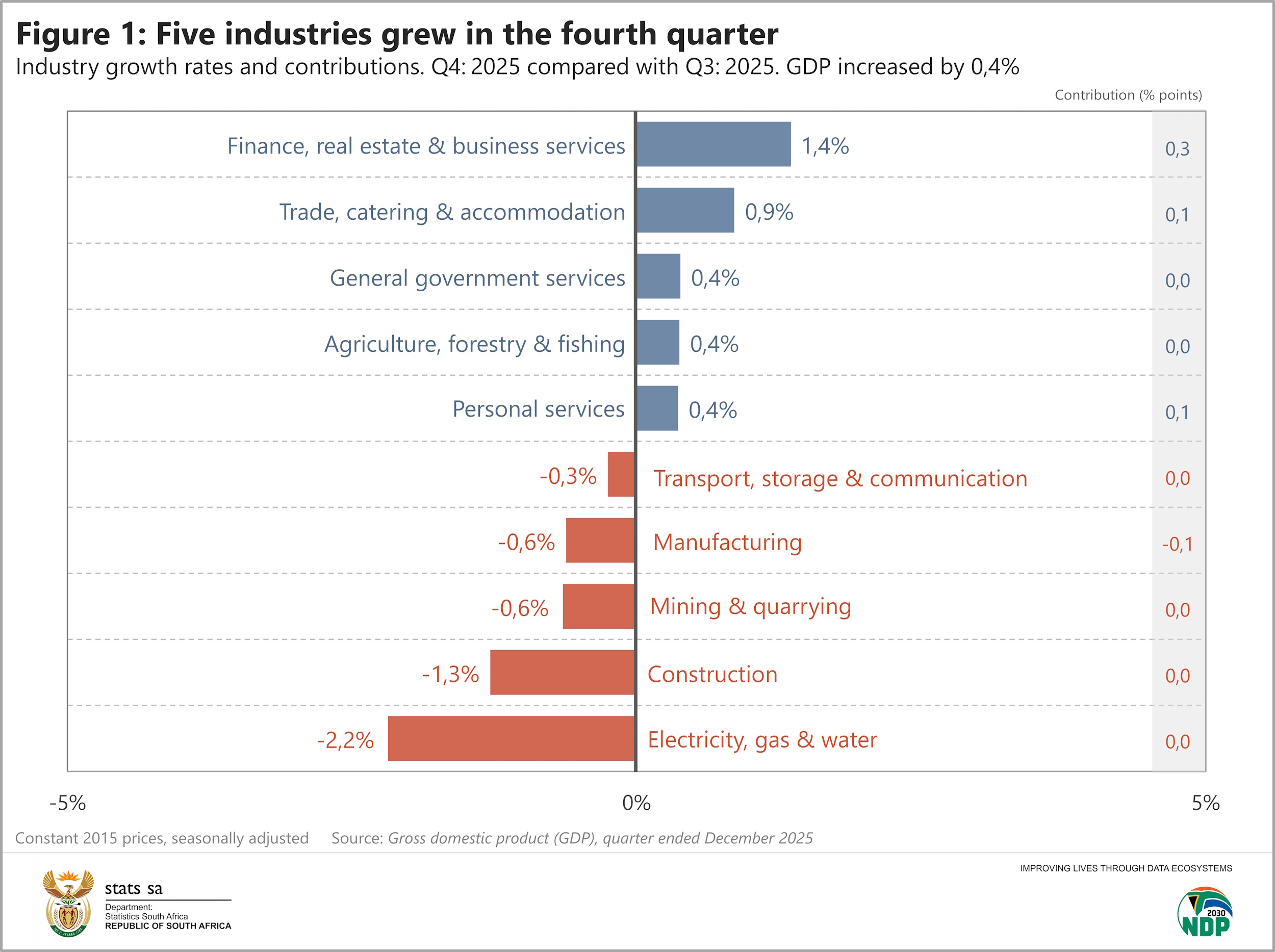
South Africa’s manufacturing sector is often discussed in simple terms. Growth is either strong or weak. Factories are either expanding or contracting. The latest data from Statistics South Africa tells a more nuanced story. GDP expanded modestly in the fourth quarter of 2025, yet manufacturing output declined while service industries such as finance and trade continued to grow. At first glance this appears to signal industrial weakness. A closer look suggests something more interesting. The sector may be entering a period of strategic restructuring rather than simple decline.
Manufacturing Remains a Core Economic Engine
Manufacturing continues to contribute hundreds of billions of rand in value to the South African economy and supports a vast network of suppliers, logistics providers and export markets. Automotive production, food processing, metals fabrication and industrial equipment manufacturing remain central to the country’s productive capacity. However the operating environment for manufacturers has become significantly more complex. Energy reliability, logistics constraints, global competition and capital costs are influencing how companies approach expansion. In response many manufacturers are changing their investment strategies.
The New Industrial Question: How Should Capital Be Deployed
Historically industrial growth was measured by how many new factories were built. Today the more relevant question is how capital is structured inside existing industrial businesses.
Manufacturers are increasingly evaluating investments in areas such as:
• automation and robotics
• advanced machinery upgrades
• energy independence solutions
• digital production systems
• export oriented production lines
These projects require carefully structured capital solutions.
A Cycle of Consolidation Is Emerging
Another pattern visible in slower industrial cycles is consolidation. When growth moderates, several things begin to happen across the sector.
- Some companies seek strategic partners to fund expansion.
- Others explore acquisitions to increase market share.
- In certain cases business owners consider exiting or selling their operations to larger industrial groups.
These dynamics are a natural part of industrial evolution. For companies with strong fundamentals, they can present significant opportunities.
The Importance of Capital Readiness
One of the biggest challenges manufacturers face is not identifying growth opportunities. It is preparing the business to secure the capital required to execute them.
Expansion projects often require:
• blended financing structures
• development finance participation
• government incentive programmes
• structured project funding
• equity partnerships
Without preparation many businesses struggle to access these funding channels. This is where financial engineering becomes critical. Preparing a business for investment, structuring capital intelligently and aligning expansion plans with available funding programmes can determine whether a project moves forward or stalls.
A Strategic Moment for Industrial Leaders
The current economic environment presents a unique moment for South African manufacturers. While production growth may appear modest, the underlying industrial landscape is shifting. Companies that begin evaluating their expansion strategy now will be better positioned when the next growth cycle accelerates. For many manufacturers this means asking strategic questions such as:
Should we expand production capacity?
Should we bring in external capital to scale the business?
Should we explore acquisition opportunities?
Should we prepare the company for a strategic sale?
These are the decisions that shape the next generation of industrial champions.
Looking Ahead
Manufacturing in South Africa and what looks like it’s disappearing, is actually evolving. The sector is moving toward a model where competitiveness is driven by capital strategy, productivity improvements and intelligent expansion planning. For industrial leaders the challenge is not simply to react to economic cycles. It is to prepare for the opportunities that follow them and in the current environment those opportunities may already be forming.